
AI Ate 89% of Our Client's Blog Traffic. Revenue Per Click Went Up 165%.
AI cut blog traffic to a Bay Area plumbing client by 89%. Revenue per click still rose 165% once local and service pages picked up the slack.
March 23, 2021
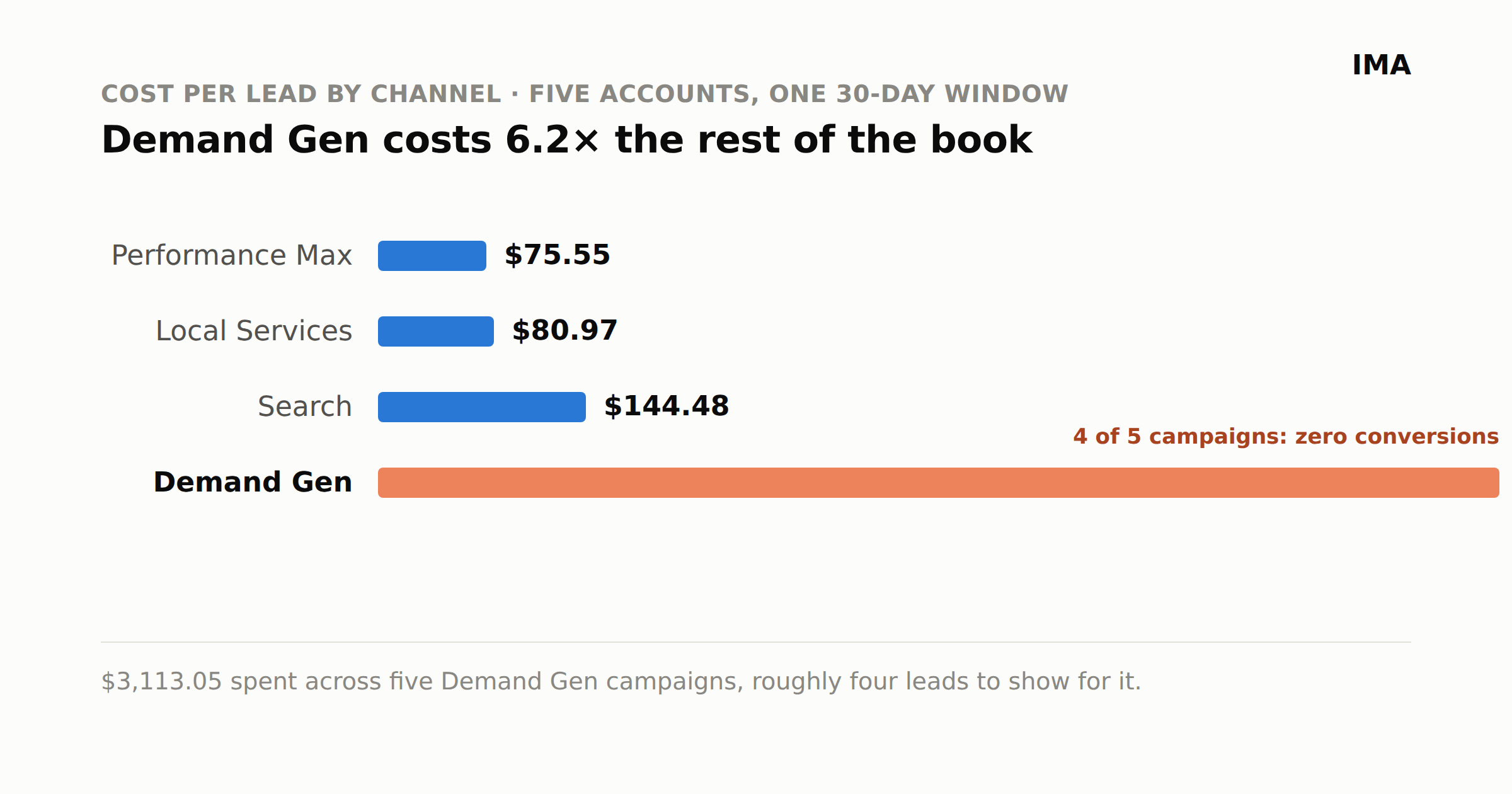
Five home-service accounts spent $3,113 on Google Demand Gen in 30 days and booked four leads. That is $779 per lead against a $125.70 book average.

Over the last 30 days, five home-service accounts in our book spent $3,113.05 on Google Demand Gen and produced 3.99 conversions. That works out to $779 per lead, against a blended $125.70 across every other channel those same accounts run.
Four of the five campaigns produced zero conversions.
I'm publishing this because Demand Gen is being pushed hard into home services right now and the pitch is landing. If your Google rep has walked you through the "you should be creating demand, not just capturing it" conversation this quarter, you're not the only one. Here is what it actually looked like in our book.
Every non-manager account under our MCC. Five of them had a Demand Gen campaign with delivery between July 27 and August 26, 2026: two electrical contractors, one plumbing company, and two home-improvement installers.
The numbers come straight out of the Google Ads API. Cost per lead is computed as cost divided by conversions rather than read from the platform's own cost-per-conversion field, which is a habit worth keeping for reasons that have nothing to do with this post.
One account in the book bills in Canadian dollars. It's excluded from every average here.
Traffic was not the problem. 563,431 impressions and 12,802 clicks for $3,113 is about 24 cents a click. That is cheap by any standard our media buyers see on search.
The problem is everything that happened after the click. 12,802 clicks produced four conversions. That's a conversion rate of 0.03%.
Demand Gen cost 6.2 times the blended rate of every other channel in the book.
Put it in plainer terms. That same $3,113, spent the way the rest of the book spends it, buys about 24 leads. It bought four.
It's actually pretty simple, and it has very little to do with Demand Gen being a bad product.
Demand Gen is a demand creation channel. It runs on YouTube, Discover and Gmail, and it puts your ad in front of somebody who wasn't looking for you. That works when the buyer has a consideration window. Something they've been turning over for a while, might do this year, could be nudged toward.
Most home services don't have a consideration window.
A burst pipe is not a consideration. A dead panel at 9pm is not a consideration. Nobody is sitting on YouTube being gently persuaded toward an emergency plumber. They're typing "plumber near me" into their phone with water on the floor.
You can't create demand for a burst pipe. You can only be there when it happens.
This is why search and LSA win in this book and always have. They're capture channels serving capture businesses. Demand Gen asks a capture business to run a creation play.
There's an incentive here worth naming too. Search inventory is finite. YouTube and Discover inventory is not. Google has every reason to move budget out of a channel where it's auction-constrained and into one where it can sell you as many impressions as you're willing to pay for. That doesn't make your rep wrong. It does mean the pitch arrives with a thumb on the scale, and the burden of proof sits with you.
Now here's the part that's easy to miss. Look at which account converted. It was the one selling a planned, high-ticket home improvement. Longer decision cycle, a real consideration window, an actual person browsing options for weeks before calling anyone. That's exactly the profile Demand Gen is built for.
It still came in at $379 a lead.
This is a small sample and I want to be direct about the limits, because most of them cut against my own argument.
Four conversions is not a data set. It's four, over one month, across five campaigns. If the next pull shows twenty, the conclusion changes and I'll publish that too.
Three of the five campaigns weren't funded enough to test anything. $171 over 30 days bought three clicks. $303 bought 216. Those campaigns didn't fail. They never really ran. Counting them as evidence against Demand Gen would be dishonest. The honest read is that our book has a habit of opening Demand Gen campaigns at budgets that guarantee nothing gets learned, and that's our problem, not Google's.
We can't see view-through conversions in this data. This is the biggest caveat and it deserves its own paragraph. Demand Gen's entire defense is influence rather than last click, and the data behind this post reports standard conversions only. If Demand Gen is doing real upper-funnel work in these accounts, the numbers above will not show it. I'm not claiming it did nothing. I'm claiming it booked four leads.
Delivery went almost entirely to YouTube. Across all five campaigns, 563,425 of 563,431 impressions served on YouTube. Six impressions landed anywhere else. If the intent was a mixed Discover and Gmail play, that isn't what ran. And video creative for a plumbing company is a much harder job than a Discover placement.
The creative was video, and video is where most home-service accounts are weakest. If the asset is a repurposed brand reel rather than something built for the placement, then the channel is taking the blame for a creative failure.
If a rep is pitching you Demand Gen, five questions worth answering before you say yes.
1. Does your service have a consideration window?
Emergency and same-day work doesn't. Replacements, remodels, planned installs, panel upgrades, water treatment and solar do. If your revenue is mostly emergency, this channel isn't built for your business and no amount of budget fixes that.
2. Are you funding a real test or a decoration?
Under roughly $1,500 a month for 30 to 60 days, you aren't learning anything. Either commit enough to get a readable answer or leave the money in search.
3. Have you decided what counts as success before you start?
If you plan to defend the campaign on view-through and assisted conversions, turn that reporting on and agree the threshold at the beginning. Reaching for view-through after a bad last-click month isn't analysis. It's a rescue.
4. Is the creative built for the placement?
A 30-second brand video cut down from your homepage is not a YouTube asset. If you aren't going to make something for the channel, don't buy the channel.
5. What is the same money worth in your best channel?
Almost nobody asks this one. Every dollar into Demand Gen is a dollar not in LSA, where this book is paying $80.97 a lead. A Demand Gen test isn't competing against zero. It's competing against the best thing you already have running.
We're not shutting Demand Gen off across the book. Two things are happening instead. The team is consolidating the underfunded campaigns so the money sits behind one properly funded test, in the one account that actually has a consideration cycle. And we're turning on view-through reporting first, so the next version of this post can answer the question this one can't.
That's the whole finding. $3,113 in, four leads out, on a channel that's a poor structural fit for most of what home services sell.
Worth knowing before your next budget call. I'll re-run this in 90 days and publish whatever it says.
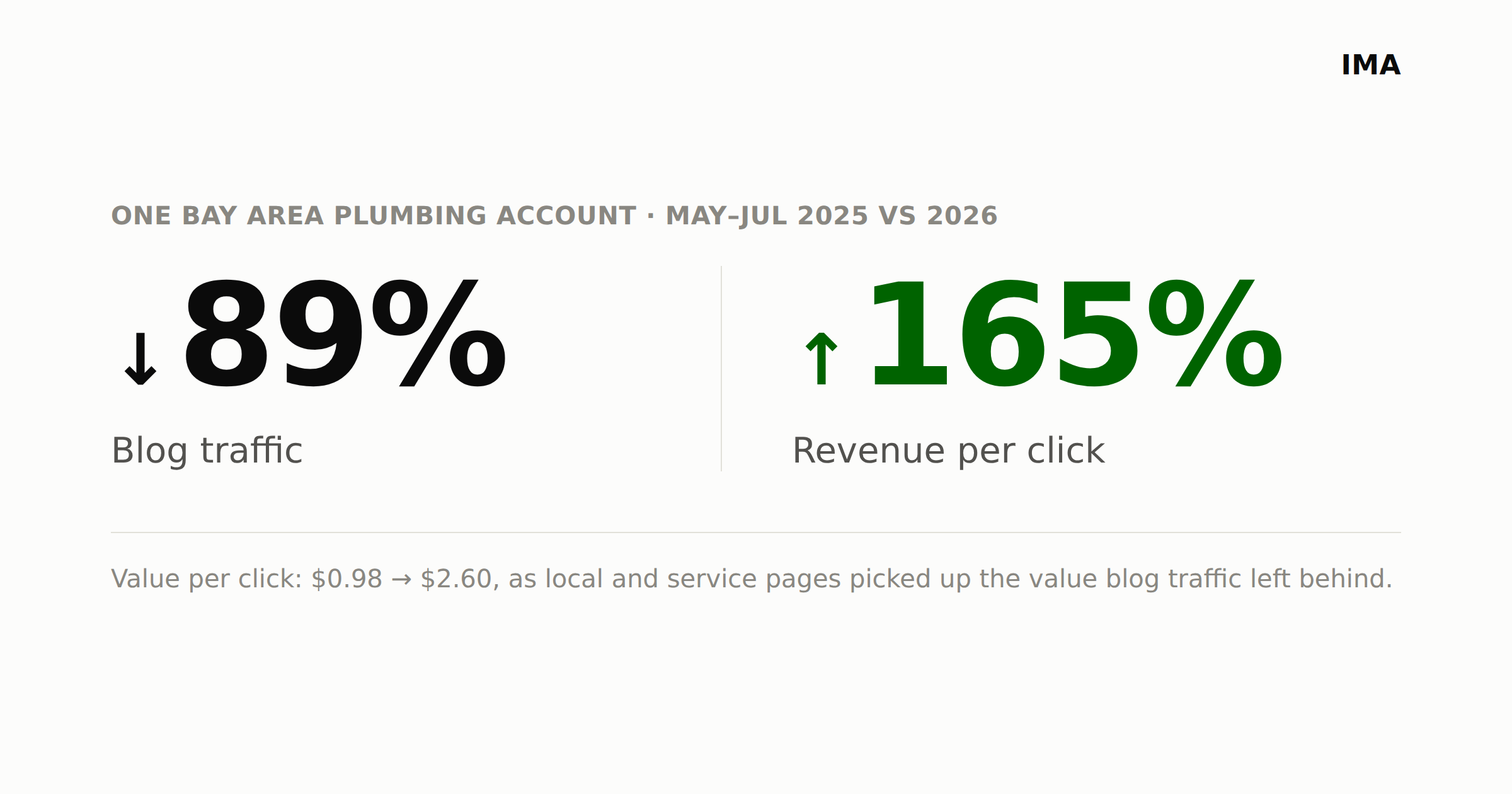
AI cut blog traffic to a Bay Area plumbing client by 89%. Revenue per click still rose 165% once local and service pages picked up the slack.
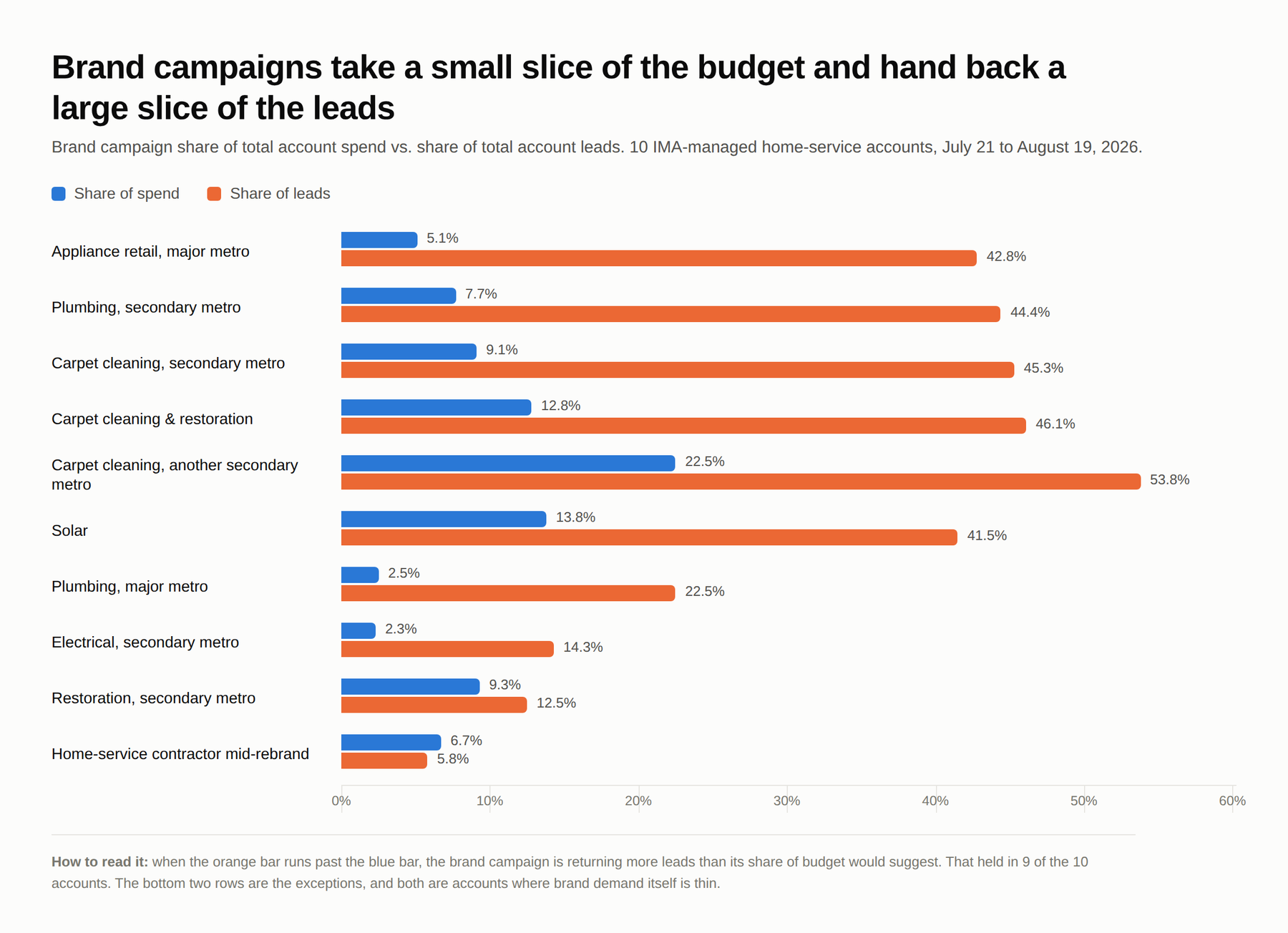
In one plumbing account spending almost six figures the brand campaign was 2.5% of spend and 22.5% of leads. We checked that pattern across 10 home-service accounts.
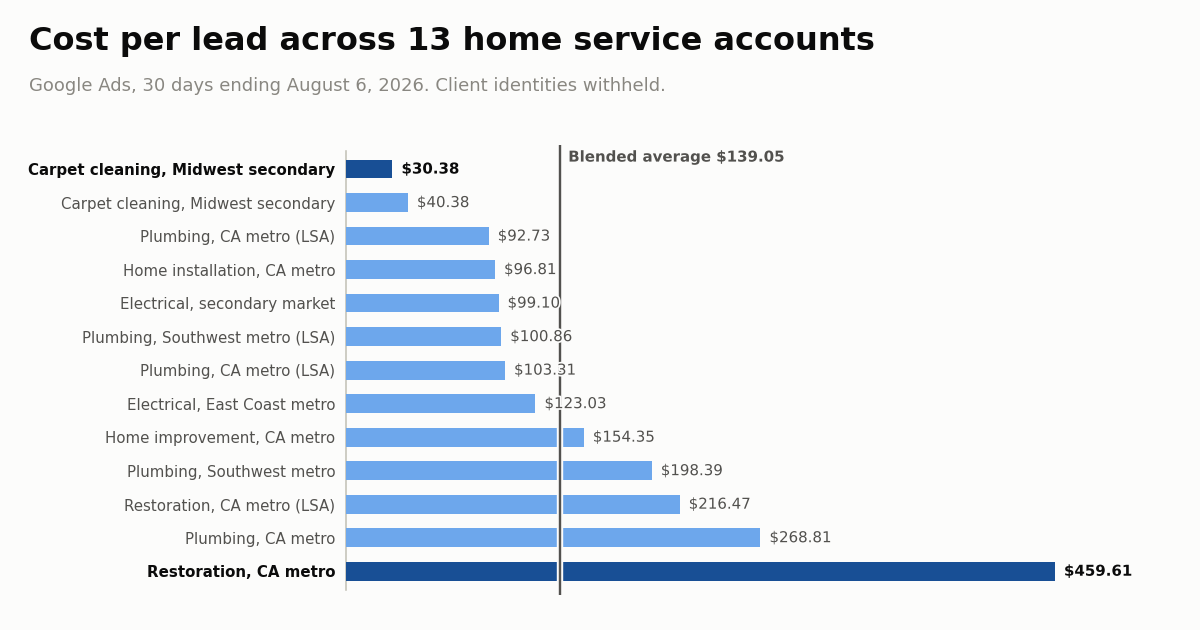
Across a sampling of Google Ads accounts, cost per lead ranged from $30.38 to $459.61 in 30 days, a 15x spread. Here is what actually drives it.Acos