
AI Ate 89% of Our Client's Blog Traffic. Revenue Per Click Went Up 165%.
AI cut blog traffic to a Bay Area plumbing client by 89%. Revenue per click still rose 165% once local and service pages picked up the slack.
March 23, 2021
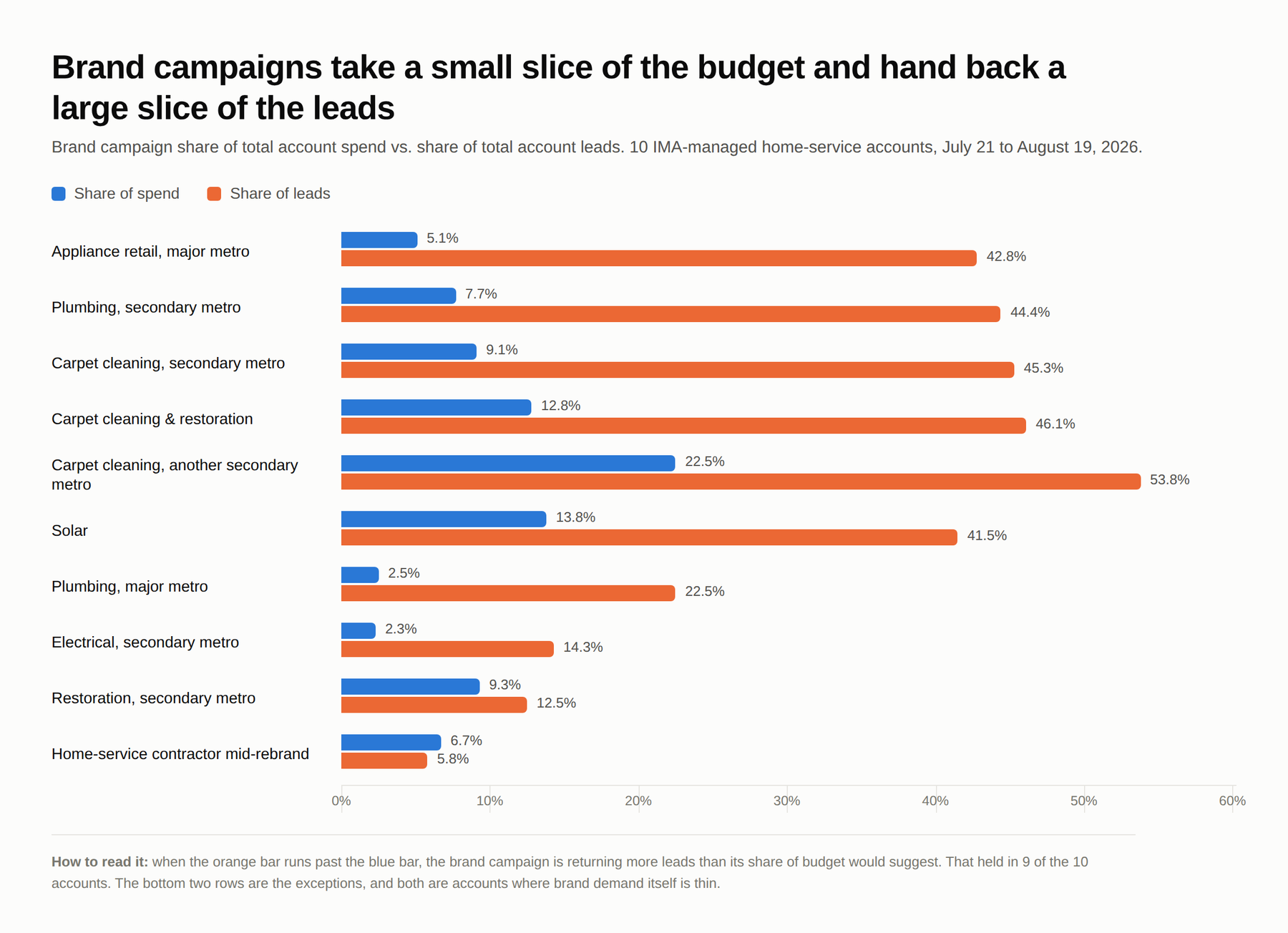
In one plumbing account spending almost six figures the brand campaign was 2.5% of spend and 22.5% of leads. We checked that pattern across 10 home-service accounts.

In one plumbing account spending almost six figures, the brand campaign took 2.5% of the media budget last month and produced 22.5% of the leads. That campaign booked leads at $27.79 while every other campaign in the account averaged $317.60.
Same account. Same month. Same service. An 11x gap in what a lead costs.
Every owner eventually asks why they are paying Google for their own name. It is a fair question and it deserves a real answer, not a slogan. So we went and looked at the whole book.
We pulled campaign-level cost and conversion data for every account in our book that runs a dedicated brand campaign. Ten accounts qualified. The window is July 21 through August 19, 2026.
The accounts cover plumbing, electrical, solar, restoration, carpet cleaning, and appliance retail, across major metros and secondary markets.
Brand campaigns were identified by campaign structure, then everything else in the account was pooled as non-brand. Cost per lead is campaign cost divided by reported conversions. No modeling, no attribution adjustments, no smoothing. This is what the platform reported.
Brand was the cheaper lead in nine of the ten accounts. In nine of the ten, brand's share of leads was larger than its share of spend. The median gap was 6.5x.
Read the two share columns together. That is the whole argument.
It is actually pretty simple. Three things compound at once.
Someone typing your company name is at the end of their decision, not the start. They already saw the truck, or got the referral, or read the reviews last week. They are not shopping. They are looking for your phone number.
Google rewards that. You are the most relevant result for a query that is literally your name, so Quality Score runs high and cost per click runs low. The same account is paying full freight to fight for "water heater repair near me" against every contractor in the county.
Then the conversion rate does the rest. High intent traffic at a low click price converts at a multiple of cold traffic. Cheap clicks and a high conversion rate multiply. That is the gap.
This is the part most people miss: the brand campaign is not performing well because the ads are good. It is performing well because it is harvesting demand that the rest of the marketing already created.
Now here is where it gets interesting, and where most agency posts stop short.
The obvious objection to everything above is incrementality. Some of those brand leads would have found you anyway. They would have scrolled two inches down to the map pack or the organic listing and called the same number. On that view, the brand campaign is buying leads it already had.
That objection is partly right, and I am not going to pretend otherwise. Not every brand lead is net-new. Anyone selling you that is selling you something.
The honest case for a brand campaign rests on two things you can actually control.
The first is defending the page. If you are not there, someone else is. Competitors, lead aggregators, and franchise networks all bid on your name. When a customer searches for you and sees a competitor's ad first, you paid for that click anyway. You just paid in a lost job instead of a $12 click.
The second is controlling the message. The organic result gives you a title tag. The ad gives you the offer, the phone number, the financing line, the review count, and the sitelinks that route an emergency call to the emergency page. On a search where someone has already decided to call you, that control is worth more than the click costs.
Defend the page, control the message. That is the argument. Not "every brand lead is free money."
The pattern broke completely in one account, and the exception explains the rule better than the rule does.
That contractor is working through a rebrand and currently bids on two company names, one of which is barely a year old in the market. Brand CPL came in at $137.60 against $118.52 for everything else. Brand was the more expensive way to buy a lead, and its share of leads came in below its share of spend.
Here is what is really going on. Brand campaigns are cheap because the brand already has demand. That account is bidding on a name a meaningful share of the market has not learned yet. There is nothing to harvest. You cannot convert demand that does not exist.
The restoration account is a softer version of the same thing. Only a 1.4x gap, and brand's lead share barely cleared its spend share. Restoration is an emergency category. When a pipe bursts at 2am, nobody searches a company name. They search the problem. Brand demand in that category is thin because the buying moment does not run through brand recall.
Both exceptions point in the same direction. Brand campaigns convert existing demand. They do not create it.
Five things, in order.
1. Separate brand into its own campaign. If your brand keywords are sitting inside a general campaign, none of this is measurable. You cannot manage a number you cannot see. This is the most common version of the problem across accounts we audit.
2. Check whether it is budget capped. This is the one that costs real money. The cheapest lead source in the account should not be hitting a ceiling at noon. When brand is capped, you are turning away your highest-intent traffic to keep funding your most expensive.
3. Compare the two share numbers. Put brand's share of spend next to its share of leads. If leads share is well above spend share, the campaign is underfunded. That comparison takes two minutes and it is the fastest read on whether the allocation is wrong.
4. If brand CPL is near or above non-brand, stop and read it correctly. That is not a bidding problem you can optimize your way out of. It is a demand problem. The answer is not a better brand campaign. The answer is whatever builds name recognition in that market, and the brand campaign gets valuable later.
5. If you want certainty, test it. Pause brand for two weeks and watch total account leads, not brand leads. Brand leads will fall. The question is whether total leads fall with them. That test settles the incrementality argument for your business, which is the only place it can actually be settled.
Brand campaigns are usually the cheapest line item in a home-service account and the first one owners want to cut. That instinct comes from looking at the wrong number.
The number that matters is not what the campaign costs. It is the distance between what it takes and what it returns. In nine of ten accounts we looked at, that distance said the same thing.
And in the tenth, it told us something more useful: that account has a demand problem the ad account cannot fix.
Figures are from IMA-managed Google Ads accounts for July 21 through August 19, 2026. Client identities are withheld; accounts are described by trade and market size only. Cost per lead is total campaign cost divided by total reported conversions, not the Google reported cost-per-conversion field.
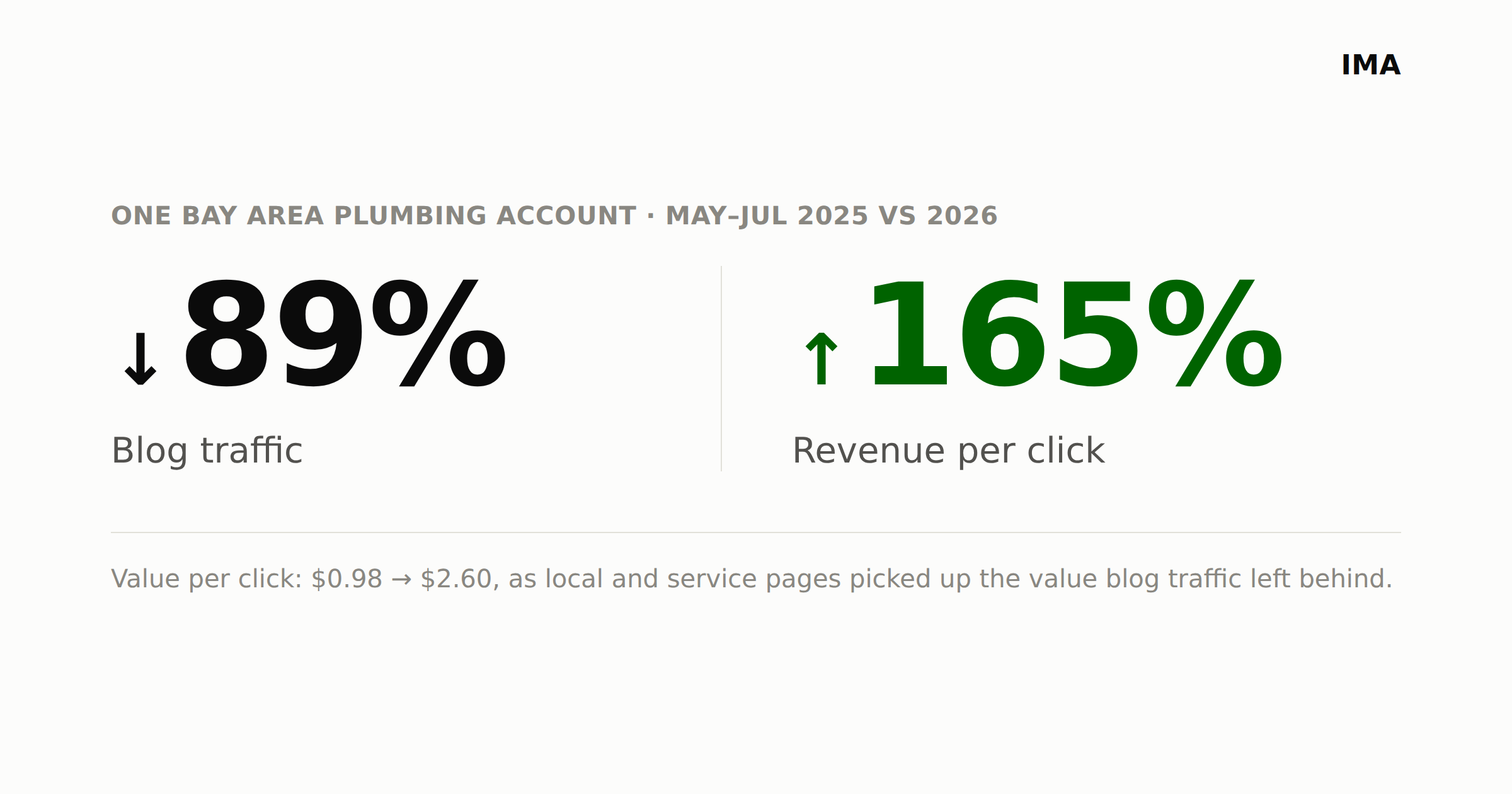
AI cut blog traffic to a Bay Area plumbing client by 89%. Revenue per click still rose 165% once local and service pages picked up the slack.
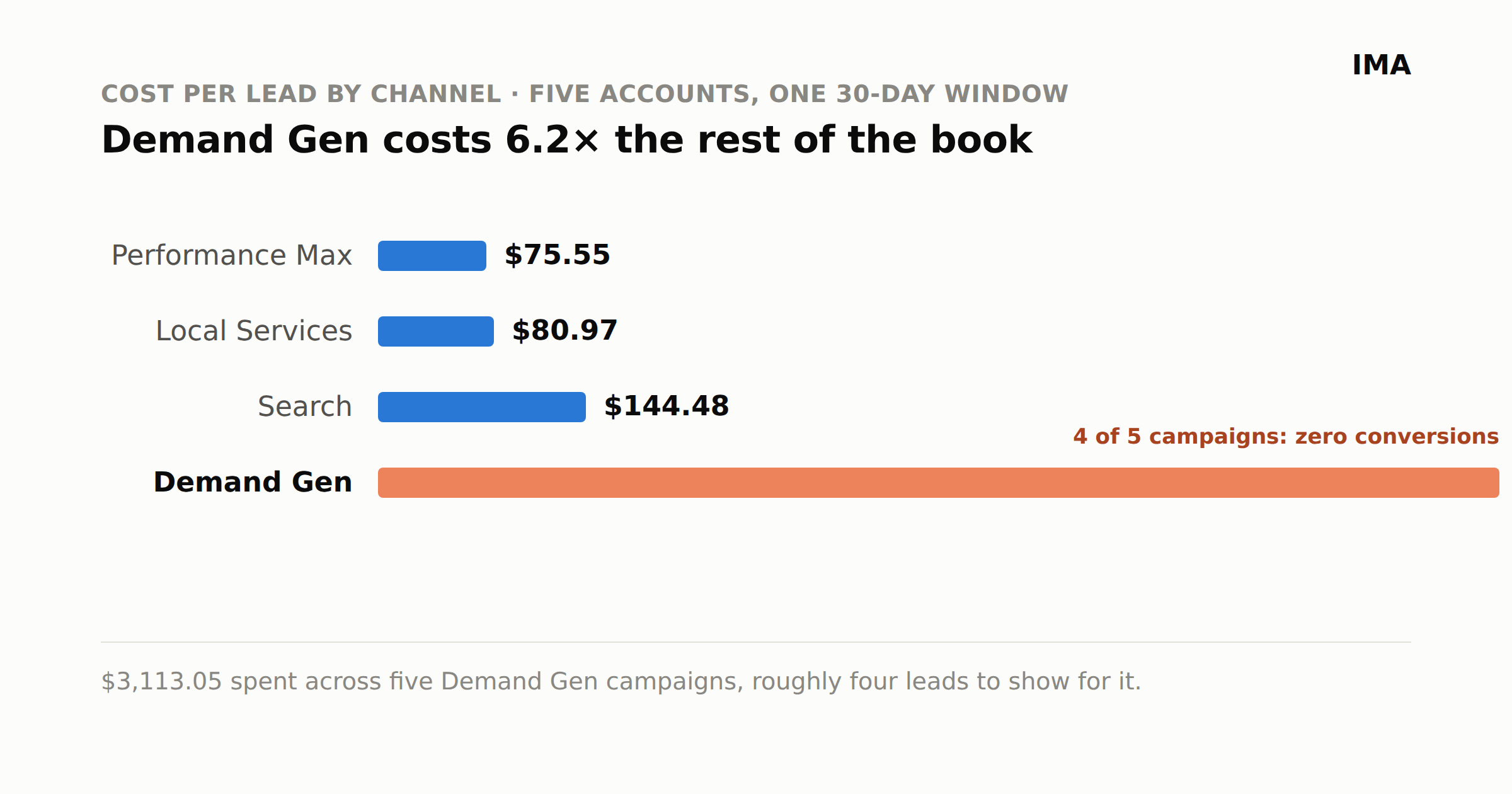
Five home-service accounts spent $3,113 on Google Demand Gen in 30 days and booked four leads. That is $779 per lead against a $125.70 book average.
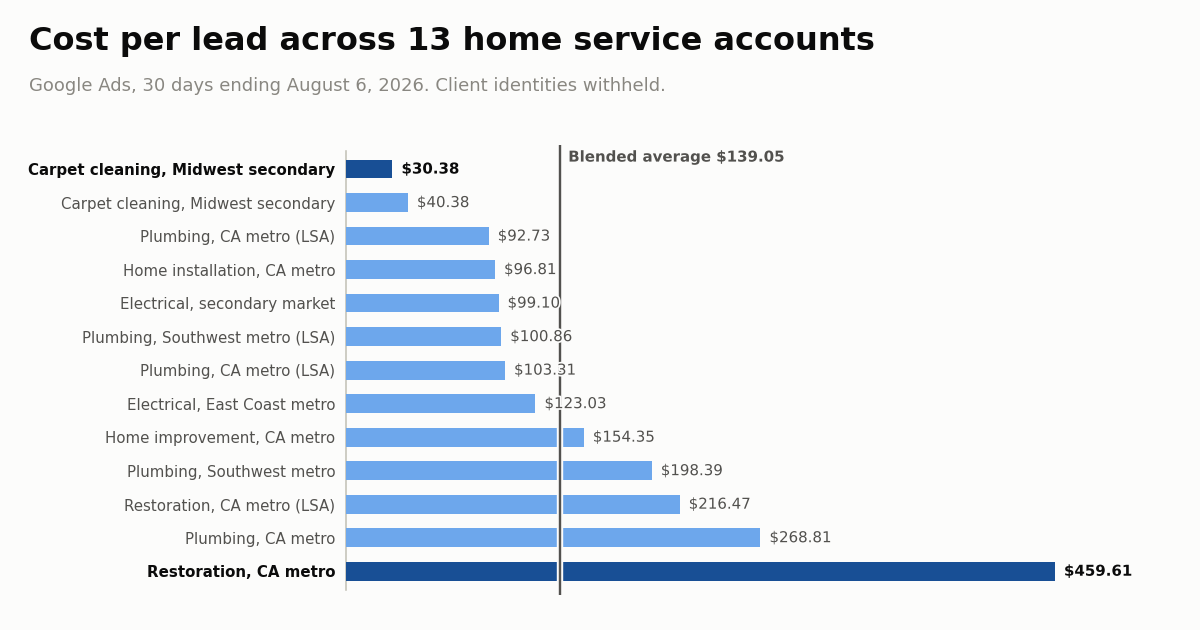
Across a sampling of Google Ads accounts, cost per lead ranged from $30.38 to $459.61 in 30 days, a 15x spread. Here is what actually drives it.Acos